Afghan Culture's Impact on Families
By Khalid Rahimi / Sep 26
As you embark on this journey through Afghanistan's historical trade routes, consider the profound impact these pathways have had on shaping cultures and identities. What stories do these ancient corridors tell about human interaction and resilience? Let’s delve into the key takeaways from this rich narrative.
Afghanistan's unique geographical position has historically made it a pivotal hub for trade and cultural exchange, connecting diverse regions and shaping its rich identity. The visual below highlights its central role in key trade networks, the influence of major empires, and the resulting cultural diffusion.
Afghanistan has long been recognized as a significant crossroads in historical trade, a position that has shaped its culture and identity over centuries. Its location at the heart of Central Asia made it an essential hub for various trade routes, connecting the East and West. This unique geographical position allowed Afghanistan to serve as a vibrant marketplace where diverse cultures, ideas, and goods converged, leading to a rich tapestry of historical interactions.
As I delve into the fascinating history of Afghanistan, I invite you to join me on a journey through time, exploring the intricate connections that have defined this remarkable nation. Let’s uncover the stories behind its trade routes and their profound influence on Afghan society!
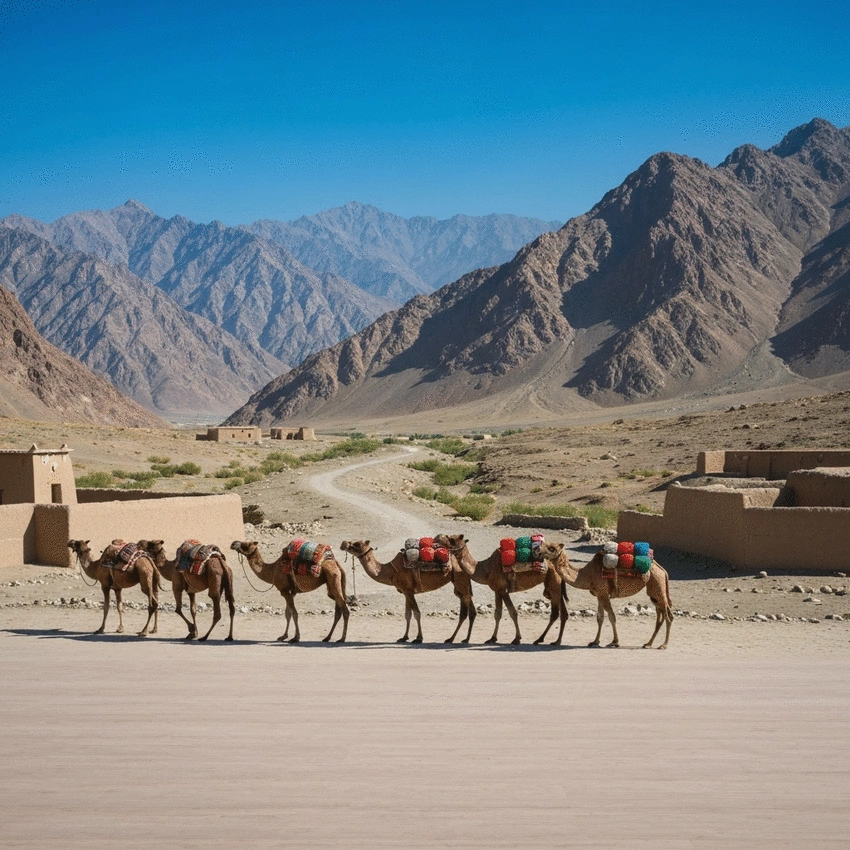
Afghanistan played a vital role in the famed Silk Road network, which facilitated trade between Asia and Europe. As merchants traveled these routes, they transported not just silk but also spices, precious stones, and other goods that enriched the economies of the regions involved. The bustling caravans that traversed Afghanistan's mountains and valleys became conduits for cultural exchange, making the country an integral part of the Silk Road's legacy. For more details on Afghanistan's role, refer to UNESCO's information on Afghanistan and the Silk Road.
This vibrant commercial activity allowed for the sharing of ideas and technologies, contributing to Afghanistan’s historical significance as a center of trade and cultural interaction.
In examining Afghanistan's historical trade routes, several key corridors emerge as particularly significant. Routes like the Northern Silk Road, which traversed through the region of Balkh, and the Southern Silk Road, connecting to the Indian subcontinent, played crucial roles in connecting diverse cultures. These trade corridors not only facilitated the flow of goods but also fostered an environment of learning and cultural exchange.
Understanding these routes gives us insight into how trade shaped the historical landscape, influencing both the economy and the diverse cultural fabric of Afghanistan.
The trade dynamics in Afghanistan were significantly shaped by major empires throughout history, including the Persian Empire, the Mughal Empire, and the Kushan Empire. Each of these empires left their mark on the trade routes, impacting cultural interactions and exchanges. For instance, the Persian Empire established trade links that facilitated the movement of goods, while the Mughal Empire enriched the cultural heritage of the region through artistic and architectural influences. The Kushan Empire, in particular, was instrumental in significant cultural shifts, as discussed in academic research on its impact.
By exploring the influence of these empires, we can appreciate the layers of history that shaped Afghanistan's identity and its essential role as a crossroads in trade.
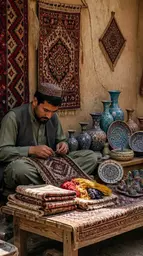
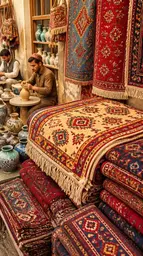
To truly appreciate Afghanistan's rich cultural tapestry, consider visiting local bazaars. These vibrant markets not only showcase unique handicrafts and spices but also serve as living museums of the country's diverse heritage. Engaging with local artisans can provide insights into traditional practices and the stories behind their crafts.
As we delve into the rich tapestry of Afghanistan's history, it's fascinating to see how the exchange of goods facilitated the sharing of ideas, religions, and technologies. This vibrant flow of cultural exchange played a pivotal role in shaping the social fabric of Afghanistan.
Merchants traversing the Silk Road brought not just spices and textiles, but also philosophies and innovations. For instance, the introduction of paper from China revolutionized communication in Afghanistan, allowing scholars to document their thoughts and ideas more efficiently.
Each of these elements not only enriched local markets but also fostered a climate of intellectual curiosity and mutual learning among the diverse ethnic groups within the region. The convergence of these ideas laid the groundwork for a complex cultural identity that continues to evolve today.
Cultural diffusion through historical trade routes deeply influenced Afghanistan's diverse ethnic and religious landscape. This process was not merely about goods passing from one hand to another; it was about narratives, beliefs, and art forms intertwining across borders.
For example, the spread of Islam through trade significantly transformed Afghan society, introducing new religious practices and values that blended with existing traditions. The result was a unique fusion that characterizes Afghan culture today.
This intricate interplay between cultures showcases Afghanistan's resilience and adaptability, as it embraced influences while maintaining its core identity. This cultural mosaic is a testament to the enduring spirit of the Afghan people. For further reading on cultural diffusion in the region, an academic paper provides additional context: Cultural Diffusion Across Central Asia.
The art and architecture of Afghanistan are vivid expressions of its historical connections forged through trade. The styles seen in Afghan buildings and artworks often reflect a blend of Persian, Indian, and Central Asian influences, illustrating how trade routes shaped their development.
Take, for example, the stunning tile work found in the mosques of Herat, which echoes the artistry from the Safavid Empire. These elements not only tell the story of artistic evolution but also signify the cultural exchanges that occurred over centuries.
This rich artistic heritage is not just a relic of the past; it continues to inspire contemporary artists in Afghanistan, reminding us of the profound impact that trade has had on shaping the nation’s unique identity.
As we explore the notable Afghan cities, we find ourselves in the heart of cultural exchange along the Silk Road. Cities like Balkh, Herat, Kandahar, and Kabul served as vital hubs, where trade and culture effortlessly intertwined.
These cities are not just dots on a map; they are storied places that have witnessed the ebb and flow of civilizations. Each city has its own unique narrative, shaped by the various peoples and empires who have passed through.
These cities not only facilitated the movement of goods but also acted as crucibles of cultural interaction, fostering an an environment where art, ideas, and traditions flourished.
One cannot discuss the historical trade routes without mentioning the accounts of travelers like Marco Polo. His observations provide us with a window into the past, highlighting the significance of trade in shaping cultural landscapes.
Marco Polo’s travels through Afghanistan reveal the vibrancy of its markets, the diversity of its people, and the richness of its cultural exchanges. His detailed descriptions allow us to appreciate the dynamic interactions that occurred along these ancient paths.
These insights remind us that the story of Afghanistan is not just one of conflict but also of resilience, adaptability, and a rich tapestry of interactions that continue to define its identity.
To better understand the cultural exchanges that have shaped Afghanistan, visual representations of trade routes are invaluable. Maps highlighting these ancient corridors not only show us the paths taken by traders but also how these routes connected disparate cultures.
These cartographic insights reveal a complex network where each route had its own significance, often enabling the flow of ideas, goods, and people across vast distances.
By examining these maps, we gain a deeper appreciation for how geography influenced cultural exchanges throughout history, weaving together the threads of Afghanistan's rich heritage.
Here is a quick recap of the important points discussed in the article:
By Khalid Rahimi / Sep 26
By Khalid Rahimi / Sep 22
By Khalid Rahimi / Sep 13